Showing posts with label textiles. Show all posts

Wednesday, 11 February 2015

knitting

''The oldest artifact with a knitted appearance is a type of sock. It is believed that socks and stockings were the first pieces produced using techniques similar to knitting. These socks were worked in Nålebinding, a technique of making fabric by creating multiple knots or loops with a single needle and thread. Many of these existing clothing items employed nålebinding techniques; some of them look very similar to true knitting, for example, 3rd-5th century CE Romano-Egyptian toe-socks. Several pieces, done in now obscure techniques, have been mistaken for knitting or crocheting.
Most histories of knitting place its origin somewhere in the Middle East, from there it spread to Europe by Mediterranean trade routes, and then to the Americas with European colonization. The earliest known examples of knitting have been found in Egypt and cover a range of items, including complex colorful wool fragments and indigo blue and white cotton stockings, which have been dated between the 11th and 14th centuries CE''

looking into the 'knot you average knit' i found quite a few piece of contemporary art that really caught my eye including this piece from karen margolis in 2009. the piece is cotton covered wire-annealed wire -acrylic

crochet

There are three main theories for the origin of crochet. Some believe that it originated in Arabia and spread eastward to Tibet and then westward to Spain, finally following the Arab trade routes to other Mediterranean countries. Alternatively, its thought to have originated in South America, where a primitive tribe used crochet adornments in puberty rites. Another alternative stems from the fact that in China, early examples were known of dolls worked in crochet.
However, there is no solid evidence as to how old crochet is or where it originated. The evidence of it appearing in the sixteenth century is slight, and hotly disputed. There are references to a type of "chained trimming" made around 1580. However this appears to have been a type of cord, sewn onto fabric like an ornamental braid.

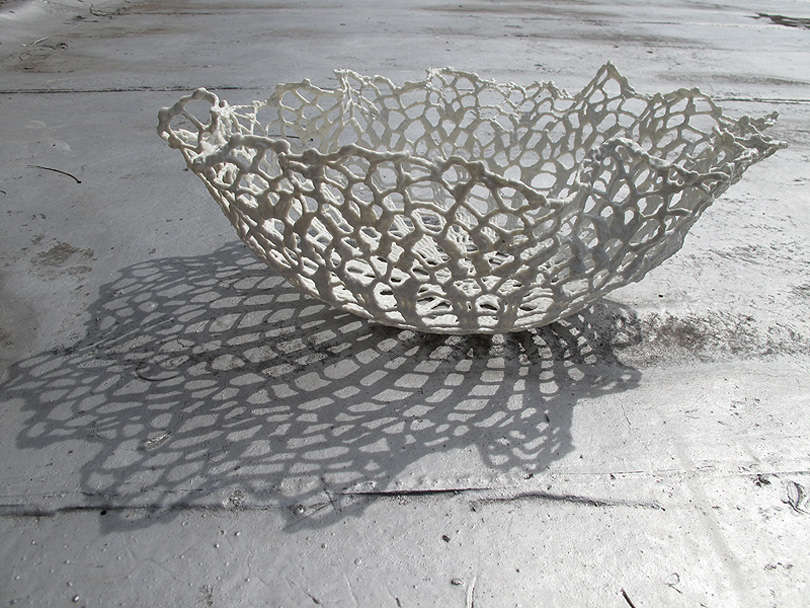
Kristen uses a unique process that she created; she crochets cotton lace shapes then dips it in liquid porcelain, fires the piece in a mold to burn away the fiber, effectively leaving behind crocheted porcelain. Each individual piece differs from the next but the art has some similarities. The porcelain lace is done in white and then set against a single, bold colored background (often, but not always, a wall). I like the natural feel of the work as well as the interesting use of background color.

Thursday, 26 June 2014

final piece for skins

my fianl piece was influenced by shells and i used the techniques macrame, reverse applique, crochet (in wax), and free machining to complete this garment.


Tuesday, 17 June 2014

free machining


To create free-motion machine embroidery, the embroiderer runs the machine and skillfully moves tightly hooped fabric under the needle to create a design. The operator lowers or covers the "feed dogs" or machine teeth and moves the fabric manually. The operator develops the embroidery manually, using the machine's settings for running stitch and fancier built-in stitches. In this way, the stitches form an image onto a piece of fabric. An embroiderer can produce a filled-in effect by sewing many parallel rows of straight stitching. A machine's zigzag stitch can create thicker lines within a design or be used to create a border. Many quilters and fabric artists use a process called thread drawing (or thread painting) to create embellishments on their projects or to create textile art.

debbie smyth

what I like about this artist is her use of pins and how from the front of the picture you cant see them yet when you look from the side the pins give it a more 3d look. the second image has more depth than the other one as it uses 2 colours and could like to use two colours on my stitch piece to give it more definition

carol coleman

the first piece is a felted background with freemachining added on top to create a rock pool effect, I like the way shes added the stones to create dimension to the piece of work and also gives it different textures.

the second is just purley felting and I like the wispy effect that has been created with the wool but also the pattern which you don't expect from this material.

vince low

  • Vince Low wanted to create art from the chaos of pen lines
  • He uses just scribbled lines to produce stunning portraits of stars
  • They were created as part of a campaign to create awareness of dyslexia

  • I like his mark making technique and in previous project have tried it free machining and it worked out well so would like to further this technique and add other techniques into the mix.

    Thursday, 5 June 2014

    applique

    ''One of the earliest examples of the art form is found in the Boulak Museum in Cairo, Egypt. It is a ceremonial canopy dating from 980 BC, which was part of the funeral tent of Queen Esi-mem-kev. The canopy is made of gazelle hide decorated with symbolic serpents and blossoms. The appliquéd pieces are dyed in various shades of pink, blue green and golden yellow. Appliqué usually decorated objects that were used in everyday life so not many examples have survived through the centuries. Surviving examples in museums include crusaders’ banners and cloaks decorated with appliquéd motifs.

    For centuries in Europe crewel embroidery using wool yarn dyed in many colors was most often used to decorate household linens. Starting in the 15th Century appliqué began to replace crewelwork on bed curtains and other linens.

    In America the use of appliqué to create household textiles began in the 18th Century. The first examples were in the style called Broderie Perse. This name, meaning Persian embroidery in French, is thought to have originated around the time of the Great Exhibition of 1851 held in London at the Crystal Palace, though the method was actually used for many years before the Great Exhibition.''

    this is just a little of the history i found out about applique.
    but i did find this piece of work where the girl has used paper as a background and think it works really well except with the skin project i would probably use a different maturial or even creating the image of scales and using that as the backing piece.

    felting

    ''Felt is the oldest form of fabric known to humankind. It predates weaving and knitting, although there is archaeological evidence from the British museum that the first known thread was made by winding vegetable fibres on the thigh. In Turkey, the remains of felt have been found, dating back at least to 6,500 BC. Highly sophisticated felted artifacts were found preserved in permafrost in a tomb in Siberia and dated to 600 AD. Felt can be of any colour, and made into any shape or size.
    Many cultures have legends as to the origins of feltmaking. The story of Saint Clement and Saint Christopher relates that while fleeing from persecution, the men packed their sandals with wool to prevent blisters. At the end of their journey, the movement and sweat had turned the wool into felt socks.''

    after scrolling through google i couldnt find an artist i liked they all were just pictures made up from felting and i wannted to look at something a little different. i then came across andrea graham which used a number of different materials and felting was one of the techniques she used to create her pieces of work. i like the way shes used the material to mold into a shape and not just left it as a 2d piece.

    rag rugging

    '' rag rug methods were brought to the shores of North America with immigrants to the new world. With some rugs, they were made only in particular regions of the country or only by certain ethnic groups. As settlement of the frontiers pushed westward in the 1900's, the rug making traditions were dispersed, and sometimes modified to take advantage of the local availability of materials. During this period, it appears that creative pioneers may have created new techniques for making rugs as well. Different techniques flourished in different sections of the country, with the various woolen rugs becoming well established in New England because of the proximity of the woolen mills. It was not until the railroads provided cheap transportation though, that wool and cotton fabrics produced on the east coast were available for most rug making in other areas. Prior to that, indeed the rugs were mostly produced by recycling worn clothing or other textiles.
    From about 1890 to 1910, rag rugs experienced a period of popularity, influenced by the "Arts and Crafts" movement. Designs became more elaborate, and many types of rugs were widely made. With the coming of World War I and the "Roaring Twenties", interest in traditional rug making waned, to the point where many rug making traditions were forgotten (see letters at end). During the Depression of the 1930's interest in rag rug making gained again, but the techniques used were by that time pretty much limited to hooked, 3-strand braided, loom woven and crocheted rugs, and the emphasis on the practical aspects of the rugs over rode most of the artistic developments earlier in the century. ''

    i didnt particularly enjoy this technique but after seeing what can be created by using it has made me consider otherwise. i cant find the artist that created this piece of work but really like the engery in it, although it isnt true rag rugging and is a printed on acrylic i like how theyve developed the technique to take it away from the more traditional 'granny' looking rag rugging.

    yorkshire scultputre park


    when we visited the park i found these beautiful  piece of work made from an artist that had recently just put her work up there, most of her work was wood based and these didnt particularly interest me too much but this more textile based piece did. there created with pigment, fabric and handmade linen fabric and really liked the natural effect created. but what i would like to do if i was to to try this effect out is to make the ink drip and make the pieces of fabric woven a little thinner so that the efffect can be seen clearer as i think it would work better for the project title skin if i did so, also to try different colours maybe


    weaving

    ''Weaving is a method of fabric production in which two distinct sets of yarns or threads are interlaced at right angles to form a fabric or cloth. There is evidence that weaving began as early as the Paleolithic era, however it is predominantly believed to have been widespread by Biblical times. In the Islamic culture, both horizontal and vertical looms could be found all over Asia, Africa and Europe (around 700 AD) and by medieval times weaving was the most important of the craft trades. The industrial revolution saw the invention of the power loom (before everything had been woven by hand). The Jacquard loom in particular allowed complicated patterns to be woven using punch cards to determine which threads of colored yarn should appear on the upper side of the cloth''


    what i love about brookandlyn's work is the natural colours used but like thier ealier work more for the fact that they have a hint of brighter colours which make the piece of work a little more eye catching .

    Tuesday, 6 May 2014

    water tension


    white tattoos

    when looking into dermatographia it reminded of the same kind of effect as white ink tattoos do there very faint. I also wanted to look into them as it shows the difference between permanent and semi permanent 'tattoos'.

    Friday, 2 May 2014

    slow motion water balloons


    Ariana Russell

    ariana Russell has  condition called dermatographia, her immune system releases excessive amounts of histamine, causing capillaries to dilate and welts to appear, lasting about thirty minutes. This allows her to painlessly draw on her skin with just enough time to photograph the results.C-print<br />24” x 20”<br />2006